Wednesday, October 15, 2025

No Credit for Regurgitating Early Discovery

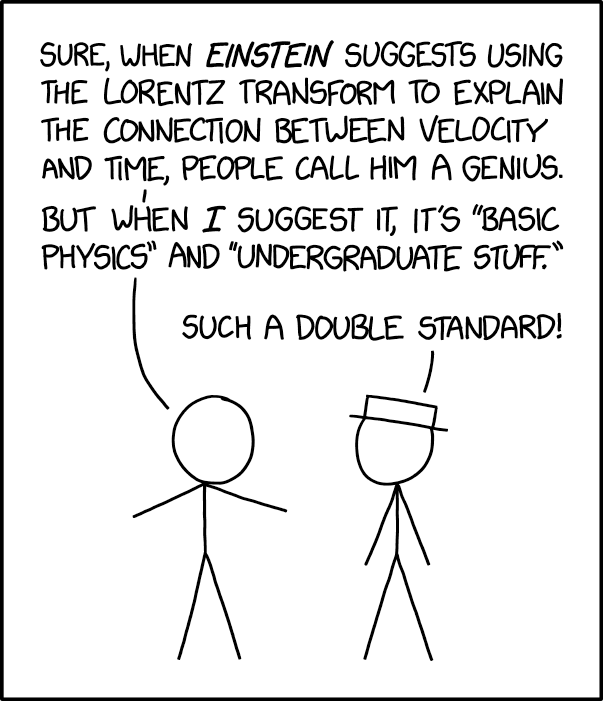
From xkcd comic.

Lorentz did publish a detailed paper on how transforms explain the connection between velocity and time, in 1895, ten years before Einstein. FitzGerald and Voigt even had some similar ideas before that. Lorentz got the Physics Nobel Prize in 1902. When Einstein published something similar in 1905, no one was too impressed. Idolizing Einstein came later.

Monday, October 13, 2025

Einstein may have Died of Syphilis

I have posted a lot about Albert Einstein, but not much about his personal life.

From a Wash. Post book review a few months ago:

Einstein’s own efforts at ascension were not entirely successful. When he tried to transform himself into a spiritual leader nearly two decades after he was celebrated for his scientific accomplishments, he founded a movement called Cosmic Religion that garnered few converts. The reaction from notable representatives of both science and faith was for the most part negative. One prominent Catholic monsignor said, “There is only one fault with [Einstein’s] cosmical religion: he put an extra letter in the word — the letter ‘s.’” Niels Bohr, upon hearing Einstein quip that “God does not play dice with the universe,” scolded him, telling him to please stop telling God what he could do.

Scholars who have studied his private life have noted that his ex-wife, Mileva Marić, who became pregnant before their marriage with a daughter who never met her father, was found lying unconscious on the road shortly before her death. She had been walking through icy streets trying to reach their younger son, whom she cared for after Einstein left the family to marry his cousin Elsa. And Elsa, in turn, eventually learned to live with infidelities so numerous that Einstein’s personal doctor claimed without evidence that the aortal aneurysm to which he succumbed was probably a result of syphilis. In light of the publication in 1993 of some of the most cruel and salacious aspects of his private life after years of litigation against the Einstein estate, his granddaughter Evelyn Einstein felt vindicated: “Nobody likes to see their sacred cow criticized, but it is about time the real story came out.”

It links to a 1994 book saying Einstein was a misogynist who abandoned and mistreated his children.

Einstein historian Galina Weinstein has her own criticism of the book reviewed above, and she just tweeted about it. While she vigorously defends him on many fronts, she does not seem to deny that he was a horrible person in his private life.

His political views were also abominable, as he belonged to several Communist front groups.

He was primarily known as a physicist, so maybe he should be judged solely on that. Okay, I could accept that, until I read Einstein scholars saying that we must accept his accounts of how he discovered relativity, and that we should not denigrate him in a way that evokes ugly Jewish stereotypes.

No, he lied about relativity all his life. I do not accept anything he said, unless it can be independently verified. I don't think it necessarily has anything to do with being Jewish. Most Jews are much more honorable than Einstein.

Friday, October 10, 2025

Weinstein Against Einstein Ad Hominems

I criticized Galina Weinstein, and commented on another rebuttal. Now she has posted a 19-page response:
This paper provides a systematic response to the criticisms raised by Jean-Marc Ginoux in response to my review of his book on the history of relativity. Whereas my review was written in a strictly academic manner, Ginoux's commentary intermingles mathematical objections with ad hominem insinuations about both Einstein and me.
She is the one with the ad hominems, as you shall see below. She avoids the biggest criticisms from Ginoux and myself.
Ginoux argues that Einstein’s retrospective statements—such as his 1955 letter to Carl Seelig, in which he wrote that he was unaware of Poincaré’s 1905 note [Bor] — should be dismissed because “Einstein, like many others, lied to his wife, his children, and also to his colleagues. So, why should we believe what he says about this article?” [Gin-2]. This reasoning collapses private life into a wholesale claim of intellectual dishonesty.

Methodologically, that is untenable; the personal failings of a scientist cannot be marshalled as evidence against their scholarly testimony. To reduce the question of influence in the genesis of special relativity to judgments about moral character is to leave the historical method for insinuation. As Einstein once remarked, “In the past, it never occurred to me that every casual remark of mine would be snatched up and recorded. Otherwise, I would have crept further into my shell” [DuHo].1

[footnote] ... There is also a well-documented polemical tradition casting Einstein as dishonest or derivative. ...

The substantive historical debate is, of course, legitimate: Did Einstein, before mid-1905, have direct knowledge of Poincaré’s work on Lorentz invariance? Were his results anticipated, and if so, in what sense? ...

What is not acceptable is to dismiss Einstein’s retrospective testimony by means of personal denigration or to frame the debate in terms that echo long-standing prejudicial tropes.

Einstein was not just dishonest in his personal life. He lied about the origins of relativity his entire life. It is not just that his 1905 relativity paper cited no references, but his followup papers, review papers, interviews, and everything else avoided Poincare. He just mentioned Poincare a couple of times in his whole life. As she says in the footnote, his dishonesty and plagiarism is well-documented.

She has a lot of discussion about the many striking similarities between Einstein and prior Poincare publications. In particular, using light signals to synchronize clocks, and postulating the relativity principle. Scholars disagree on how much was plagiarized. The most compelling point to me is that he never came clean, and tried to explain which Poincare works he used, or to credit Poincare's priority.

Einstein did eventually explain that his relied on Lorentz's 1895 relativity theory, constant speed of light, contraction, analysis of Michelson-Morley, and local time, and denied that he read Lorentz's 1904 paper. Maybe he was telling the truth, although Logunov presents evidence that Einstein read that 1904 paper. Einstein published 21 reviews in a journal that also reviewed Lorentz's paper, so it is hard to see how he could have missed it.

But there is no explanation like this for Poincare. Poincare was possibly the most widely read scientist in all of Europe, and Einstein read French. It is a certainty that Einstein read Poincare's relativity works. Even if Einstein's failure to cite Poincare in 1905 is somehow excusable, there can be no excuse for not crediting him in later papers.

She says that the debate is over whether Einstein knew about Poincare's works, and it is unacceptable to question his integrity. Yes, of course I am going to question his integrity, because that is the only way to answer the question. There is no historian who says Einstein did not know about Poincare's works, and no historian who has any excuse for Einstein not citing Poincare.

Her strangest comment is to say that Einstein's honesty must not be questioned, because it is unacceptable "to frame the debate in terms that echo long-standing prejudicial tropes." Apparently this is a veiled reference to a stereotype of Jews being dishonest plagiarists, and as being parasitic, unoriginal, morally corrupt, and eager to appropriate the achievements and culture of others. For more on this subject, see this essay on how the Nazis considered Jewish Physics inferior to Deutsche Physik.

She works for an Israeli university, and I guess it is her duty to defend the honor of a great Jewish intellectual.

Galison has offered a subtle explanation for Einstein’s style in the 1905 relativity paper. Einstein had been trained in the patent office, where clarity, compression, and originality were paramount. Patent applications never cite prior patents or scientific works, for the very logic of the system demands that the invention stand on its own, free of genealogical entanglements.
I am a patent agent myself, and this is false. Patent applications nearly always cite prior patents and scientific works. The whole point of the application is to show that the invention is different and better than the prior art. Even if an application did not include references, the patent examiner would add them. They are essential.
Ginoux’s argument hinges on Einstein’s use of the word überflüssig (“superfluous”) in his 1905 relativity paper, as if this meant that Einstein only sidestepped the ether rather than abolishing it [Gin-2]. This reading is misleading. In German scientific usage, überflüssig means not “almost unnecessary,” but “dispensable,” “without function,” “obsolete.” When Einstein writes that the introduction of a “light ether” will prove überflüssig, he is saying that the ether is not required to account for electrodynamic phenomena. That is abolition in the strictest physical sense.
That is still essentially the same as Lorentz's 1895 paper saying "It is not my intention ... to express assumptions about the nature of the aether." And Poincare saying in 1889, "Whether the ether exists or not matters little - let us leave that to the metaphysicians". (The word can be spelled aether or ether.)

I think that there is overwhelming evidence of plagiarism, but regardless, the fact remains that Einstein's 1905 paper added nothing to the relativity theory created by Lorentz and Poincare. They had the Lorentz group, 4-vectors, spacetime metric, covariant Maxwell equations, and gravity. Einstein had a lesser theory, similar to what Lorentz had in 1904.

So even if Einstein rediscovered some aspects of relativity independently, he was merely giving a version of a theory that had already been published.

She asks whether Einstein's 1905 results were anticipated? The answer is yes, that everything in that paper was done better in previous publications.

She ends by saying that Poincare did cite Einstein in his last 1912 lecture:

ELECTRON DYNAMICS

more precise, this principle will be verified with more precision." In 1901, H. A. Lorentz had modified his theory so as to account for all observations, including Michelson's. He already used the "Lorentz transformation." The confidence inspired by the equations of the electromagnetic field was so strong that no one thought of correcting them, but rather tackled kinematics and mechanics, imagining that they must be affected by absolute motion in order to compensate for the influence of this motion on the phenomena of electrodynamics. But it is in the 17th volume of the Annales of Physique 1905 that we find Einstein's work on the principle of relativity considered in a methodical manner.

I do not even get the point of most of her arguments. Yes, Poincare acknowledged that Einstein published a paper on relativity. So what?

She starts her paper saying:

the difference between formal structures — equations, group properties, calculational devices — that were indeed available to Lorentz and Poincaré by mid–1905 and the conceptual framework inaugurated by Einstein in June 1905, in which simultaneity is practically defined, the ether is rendered superfluous, and the Lorentz transformation is derived from two coequal postulates. My aim here is not to diminish Poincaré’s formidable contributions; it is to clarify what counts as founding a theory, and to separate reconstruction from documentation.

In what follows, I confine myself to dated publications, manuscripts, and verifiable correspondence. I avoid psychologizing — about Einstein, myself, or any other figure — and I do not treat private life or character judgments as evidence. Priority and influence should be argued from documents, not insinuations.

In his comment, Ginoux challenges my interpretation of Einstein’s independence in 1905 and, in doing so, introduces remarks that go beyond scholarly disagreement. While my review was written in a strictly academic manner, addressing only the content of his book, his reply includes ad hominem statements about both Einstein and me.

No, not really. Her aim is very much to diminish Poincare, and to slander anyone who criticizes Einstein.

If she confined herself to verified sources, then the inescapable conclusion is that Lorentz and Poincare had all of special relativity in 1905. That is what Whittaker concluded in his 1953 book. If she and the other Einstein scholars were to simply describe what Lorentz, Poincare, and Einstein published, then I would have no quarrel.

No, she argued that Poincare's understanding was deficient. That he failed to take the decisive step. In the above quote, she argues that Poincare having all the formal structures does not count as founding the theory. And she later insinuates that any disagreement is based on Nazi tropes.

She could have recited what Lorentz, Poincare, and Einstein said about the aether, but that would not convince anyone to credit Einstein. She could explain how simultaneity is practically defined, but that would be Poincare's papers of 1898, 1900, and 1904. Likewise, she could have explained how they each derived the Lorentz transformations, but it is not clear why one would be better. Relativity textbooks commonly give other derivations as well. She could explain Einstein's two postulates, but she would have to say that they were published by Lorentz and Poincare years earlier.

So that leaves crediting Einstein for re-deriving the Lorentz transformations "from two coequal postulates", neither of which was original to him. That's all. Poincare had the postulates, but I guess he did not say that they are "coequal", whatever that means.

By comparison, Poincare had the Lorentz group, 4-vectors, spacetime metric, covariant Maxwell equations, and gravity, all in 1905, and all years before Einstein even understood these concepts. The canonical special relativity theory of 1910 until today is the one we got from Lorentz, Poincare, and Minkowski, not Einstein.

She argues:

The real point of contention is not whether Poincaré made profound contributions — he did — but whether Einstein’s 1905 paper represents merely an echo of those contributions or a decisive reconceptualization. I maintain, in line with much of the existing scholarship ([Nor, Sta02] and others), that Einstein’s achievement lay in relocating the Lorentz transformations into an ether-free, principle-based kinematics.
I thought she was going to say that Einstein founded a new theory. No, he just had a reconceptualization of Poincare's theory. Poincare's theory was also aether-free, so the supposed achievement is the "principle-based kinematics". Poincare's theory was also principle-based. So the difference is that Poincare had a 4D spacetime theory with a Lorentz symmetry group, and Einstein had a kinematic reconceptualization, whatever that is. This is how she, and other Einstein scholars, desperately try to find something original that can be attributed to Einstein, even if it has little to do with special relativity theory.
Wednesday, October 8, 2025

No Nobel for Quantum Supremacy

Some were hoping that the Nobel Physics Prize would go to Google or IBM for proving quantum supremacy. Instead, the Swedes announced:
“This brings quantum physics from the subatomic world onto a chip”
One of the recipients led Google's quantum supremacy work, but that was conspicuously absent from the announcement.

The obvious conclusion is that the Swedes had a hot debate on awarding quantum computers, but decided against it.

Monday, October 6, 2025

Galina Weinstein tries to Retrofit Einstein Again

Israeli scholar Galina Weinstein describes herself:
Specialist in Einstein’s Writings & Theories. I specialize in Einstein studies and have published extensively on the topic.
She just posted yet another paper on why Einstein deserves all the credit for special relativity, while Lorentz and Poincare were too stupid to know what they were doing.
Lorentz, Poincaré, and Einstein: Rethinking Doppler, Aberration, and the Fresnel Drag

Galina Weinstein

This paper examines Lorentz's 1895 derivations of the classical Doppler formula and Fresnel drag, Einstein's 1905 derivation of the relativistic Doppler effect and aberration, and Einstein's 1907 kinematical route to the exact velocity composition law from which Fresnel drag is obtained as a low-velocity limit. Einstein acknowledged that he had read Lorentz's "Versuch" well before 1905. In 1907, Einstein identified Lorentz's "Versuch" as a crucial precursor to relativity. In that work, Lorentz had already invoked local time to derive Fresnel's drag coefficient from Maxwell's equations. There is a genuine "family resemblance" between Lorentz's and Einstein's treatments in that both preserve the phase of a plane wave under transformation. Yet I demonstrate that this resemblance is only formal. I also discuss the absence of the relativistic Doppler and aberration laws in Poincaré's Dynamics of the Electron.

So Einstein admitted in 1907 that his famous 1905 relativity paper was based on Lorentz's 1895 Versuch paper. Einstein's 1905 paper closely resembles Lorentz's 1895 paper, as she says, but Einstein did not cite it. In other words, this was flagrant plagiarism.

Nevertheless she finds wacky reasons to ignore the plagiarism and credit Einstein. She cannot deny that Lorentz and Poincare had the whole theory before Einstein, so she has to claim that they somehow did not understand what they were doing.

I have criticized her in the past, most recently here, here, and here, and found her papers riddled with errors, smokescreens, and misrepresentations. She has not responded to these criticisms. She often criticizes other scholars, in Einstein's defense.

She keeps claiming that Einstein took the "decisive step", but she can never put her finger on what that step is.

First, that step is not "that no preferred ether frame exists." Special relativity does not depend on the aether, or lack of aether, or nonexistence of a preferred frame. These things have no bearing on the predictions of relativity. Einstein's 1905 paper did not say whether the aether exists, or whether a preferred frame exists. These are all modern misunderstandings of relativity.

Lorentz's 1895 and Einstein's 1905 papers say the same thing about the aether -- that it is not needed for the theory. Both papers choose reference frames that are "at rest" or "stationary", but emphasize that they are equivalent to other frames, in the sense that a change of variables makes Maxwell's equations look the same.

Poincare went a step further in 1905 and showed that the Lorentz transformations make a symmetry group relating the frames, and inducing relationships in the electromagnetic variables. For years, he argued that belief in the aether was a mathematical convenience.

This point is at the core of her misunderstandings.

In the above paper, she goes into detail to credit Einstein with ideas that Lorentz or Poincare published years earlier. One of her main examples is that Einstein published the velocity addition law in 1907. Poincare had already discovered it in a May 1905 letter to Lorentz, as she acknowledged in a 2012 paper. Einstein relied on the relativity principle in 1905, but that was copied from what Poincare wrote years earlier. As she explains:

Poincaré went further than Lorentz by recognizing the group properties of the transformations and emphasizing the principle of relativity. Yet he too remained within the conceptual confines of the ether, with all the limitations this entailed. ... The deeper reason is ontological. Like Lorentz, Poincaré retained the ether — conceived as a real, if undetectable, medium — as the ultimate backdrop of electrodynamics. This commitment barred him from taking the decisive step that Einstein did in 1905.
After the first sentence, this is gibberish. Poincare had a group symmetry identifying any inertial frame with any other. An undetectable aether could not possibly limit his theory. Einstein himself denied that he abolished the aether.

I am baffled as to how she can say anything this stupid. She either misunderstands relativity, or does not know what a symmetry group is, or she is bluffing with buzz words to puff up Einstein's reputation.

She has lengthy discussions of some side issues, like stellar aberration. Apparently there is some literature on whether Einstein misunderstood aberration. I have no opinion on this. Einstein's treatment was more or less the same as Lorentz's ten years earlier, and does not have much to with priority for relativity.

In the paper, she writes some formulas and then imagines that Einstein could have written them but not Poincare.

Now, that is retro-fitting Einstein’s conceptual step into Poincaré’s framework. It is not something Poincaré himself could have justified in 1905. Here, we declare the phase to be invariant under Lorentz transformations (66). In modern language, this means the phase is a relativistic scalar. This is not just a calculation move. Making the phase invariant was a conceptual step, not a purely technical one. That is a very Einsteinian step because it assumes that all inertial frames are equivalent and that no preferred ether frame exists.
What she is saying here is that Einstein would have understood the concept of a relativistic scalar, but Poincare would not have. She literally says that considering a Lorentz invariant is an "Einsteinian step".

Again, I am baffled at how she can say something so ignorant. Einstein does not have the concept in 1905, and appeared to not understand it until many years later. But Poincare has relativistic scalars in his long 1905 paper.

A relativistic scalar is a function that is invariant under Lorentz transformation. More generally, a relativistic vector or tensor obeys geometric formulas for Lorentz transformations. Sometimes these are called covariant (or contravariant) and 4-vectors or 4d tensors.

Poincare's long 1905 paper devotes several pages to finding relativistic scalars. He finds the Minkowski metric, E*B, and E²-B², where E and B are the electric and magnetic fields. The latter is particularly interesting because it forms the Lagrangian density for Maxwell's equations, with no charges. When there are charges or currents, there is an extra term.

This is all explained in detail in Henri Poincare and Relativity Theory by the Russian, A. A. Logunov, 2004.

Lorentz group invariance goes to the heart of what special relativity was all about. The chief accomplishment was to express Maxwell's equations in a way that behaves properly under Lorentz transformations, thereby realizing the Maxwell theory as a relativistic theory.

This idea is what sold everyone on the theory. The Maxwell theory had decades of experimental verification, but it left puzzles such as the inability to detect the Earth's motion through the aether. Suddenly it all made sense, with relativity.

Poincare proved this in two ways -- by providing a Lorentz invariant Lagrangian, and by using a 4-vector electromagnetic potential. Minkowski added a third, showing a covariant field tensor.

Einstein understood none of this. According to Logunov, he was still confused about it in 1933. I think he probably figured it out around 1913.

What Einstein did do in 1905 was to re-derive Lorentz's 1895 Vorsuch theorem of the corresponding states. This meant that there were ways to change variables so they satisfy a version of Maxwell's equations in a moving frame. Einstein's theory was equivalent to Lorentz's,

The preferred view today, pioneered by Poincare and Minkowski, is that relativity is a spacetime theory. The Lorentz transformations form a symmetry group of spacetime. Relativistic scalars, vectors, and tensors obey those symmetries. The laws of physics are formulated in terms of those tensors, and the switch to a moving frame is an automatic consequence of the geometry. The transformation of Maxwell's equations is induced by the transformation of spacetime.

By doing it this way, Poincare established relativity as a theory applying to all the laws of physics. He even applied it to gravity in 1905. The Lorentz-Einstein version was a way to understand the relativity of electromagnetism, but it was unclear whether and how it would apply to something else, like gravity.

I spell this out because Weinstein's arguments for crediting relativity require ignoring the heart of the theory. She says Lorentz and Poincare did not take the decisive step, but Einstein was the one not taking that step. The essence of relativity is the non-euclidean geometry on spacetime, and laws of physics respecting that geometry. Poincare and Minkowski had it, and Einstein did not.

Thursday, October 2, 2025

Quantum Computer Pessimism

Quantum computer researchers report progress all the time, but Craig Gidney reports:
In 2001, quantum computers factored the number 15. It’s now 2025, and quantum computers haven’t yet factored the number 21.
And Sabine Hossenfelder has gone negative on there ever being any applications.

Scott Aaronson attacks an HBSB-IBM announcement of quantum advantage.

Wednesday, October 1, 2025

Biggest Concepts in Mathematics

What are the most important concepts in Mathematics? Here is my list.
  1. Proof. Also logic, axiom, finitary proof.
  2. Infinity. Also limit, continuity, calculus, analysis.
  3. Set. Also number, function, more abstract objects.
  4. Symmetry. Also group, geometry, isomorphism.
  5. Probability. Also statistics, sampling, conditionals.
  6. Convexity. Also linearization, optimization.
No surprises here, except for that last one. I expect most readers to say convexity is just a trivial property of some sets and functions, and not really of fundamental importance.

That is what I used to think, but now I have concluded that convexity is at the core of most real-world applications of math.

In particular, convexity is crucial to the math of artifical intelligence AI.

Another crucial math idea in AI is:

The manifold hypothesis posits that many high-dimensional data sets that occur in the real world actually lie along low-dimensional latent manifolds inside that high-dimensional space.[1][2][3][4] As a consequence of the manifold hypothesis, many data sets that appear to initially require many variables to describe, can actually be described by a comparatively small number of variables, linked to the local coordinate system of the underlying manifold. It is suggested that this principle underpins the effectiveness of machine learning algorithms in describing high-dimensional data sets by considering a few common features.
Another is the various scaling and power laws:

In statistics, a power law is a functional relationship between two quantities, where a relative change in one quantity results in a relative change in the other quantity proportional to the change raised to a constant exponent: one quantity varies as a power of another. The change is independent of the initial size of those quantities.
With AI becoming more important, I expect the math of AI to also become more important.

Electromagnetism Derived From Geometry

General relativity teaches that gravity is a manifestation of geometry. Not everyone knows that electromagnetism and the other fundamental f...