Monday, December 1, 2025

Explanation of Newtonian Time

Matt Farr posted a new paper on Time in Classical Physics:
Wigner (1995, 334) describes how Newton’s “most important” achievement was the division of the world into “Initial Conditions and Laws of Nature”, noting that “[b]efore Newton there was no sharp separation between the two concepts. […] After Newton’s time the sharp separation of initial conditions and laws of nature was taken for granted and rarely even mentioned.” This is the central feature of the Newtonian schema.
Some people are so locked into this view that they say that indeterminism and free will are inconceivable. When you make a choice at a restaurant menu, it has to be determined by the initial conditions, or else the laws of physics are violated. No, that is just the Newtonian schema.

For example, Sabine Hossenfelder argues:

And according to new scientist, the superdeterminist view 5:20 naturally raises the possibility that the laws of physics are at odds with unlimited free will. 5:26 What are we to make of this? For one thing, this free will assumption in quantum physics, despite 5:33 its name, has nothing to do with what we normally refer to as free will in none of the definitions 5:40 that philosophers like to use.

Regardless of what you think quantum physics exactly means, the laws 5:47 of physics are always at odds with unlimited free will. This is why they're called laws. If you jump 5:54 off a bridge, you'll fall down. And no amount of free will is going to make you fall up.

She is saying that the Newtonian schema leaves no room for free will. If your initial conditions have you jumping off a bridge, the laws of physics determine your fall, and free will cannot do anything.

I think she is alluding to philosophers who try to define free will as being compatible with all your choices being determined before you were born. To those philosophers, free will is just in your imagination, and has nothing to do with the laws of physics or any actual choices you make. Most philosophers have such a nihilist view.

Yes, the Newton schema assumes that the past determines the future. That is not a law of physics. It is just an assumption. It works well approximately in a great many cases. Not all cases, if you believe in free will.

Some people also argue that the future can determine the past, in the same way that the past determines the future.

The above paper looks at what Newton said about time, and contrasts it with relativity and Lagrangian mechanics. Everyone says Newtonian time is more intuitive than relativistic time, but I am not sure. I have no intuition for anything going faster than light, as Newtonian time allows.

Lagrangian mechanics is another story. Time is just another variable, and it is not so clear how causality works. The paper tries to make sense of it.

New Scientist just released a video:

What Is Reality? Does Quantum Physics Have The Answer?

Over the past century, quantum physics has transformed science and reshaped our understanding of reality. In this special compilation from the New Scientist archive, we trace that evolution, from the birth of quantum mechanics to today’s lab-made “mini universes.”

We explore how quantum ideas revolutionised technology, how they continue to inspire new forms of creativity, and how recent breakthroughs are pushing the limits of what we can understand.

Most of it is not too bad, but it presents an expert physicist saying, about interpretations of quantum mechanics:
I think the 5:02 one that is probably most compelling to 5:04 the majority of physicists is called the 5:06 many worlds interpretation. It's 5:08 compelling because it says that 5:09 fundamentally we are also in superposition. Every possibility has a 5:14 realization in different worlds.
No, this is crazy stuff. I hope it is not true that a majority of physicists find this nuttiness compelling.

The Schroedinger Cat was once an example of silly thinking. Now this man is compelled to believe in many-worlds because he wants to believe that he is just like a Schroeding cat.

Wednesday, November 26, 2025

Quantum Computing Skepticism

I gave an online presentation on my quantum computing skepticism, and it is now posted. Thanks to the sponsors for making this happen, and persisting in the face of criticism from enthusiasts.

Tuesday, November 25, 2025

Why Einstein's Dishonesty was Tolerated

I wrote a book on Einstein, but I was never able to explain why everyone overcredits him for relativity and other wisdom.

One explanation is that most people do not know the history of relativity. Yes, that's true, but the history is well-documented for all the scholars who bother to look.

Another possible explanation is that his reputation was being propped up by friends or Jews or Leftists or others who were partial to him for some reason. But he gets plenty of exaggerated support from non-Jews and others with no obvious ties.

Galina Weinstein is an Israeli philosopher, and Einstein scholar and worshipper, and she suggests another possibility. Because the Nazis denigrated Einstein in the 1930s, an Einstein critic might get labeled a Nazi.

What is not acceptable is ... to frame the [relativity priority] debate in terms that echo long-standing prejudicial tropes.
As I commented:
Apparently this is a veiled reference to a stereotype of Jews being dishonest plagiarists, and as being parasitic, unoriginal, morally corrupt, and eager to appropriate the achievements and culture of others.
That seems rude, but Weinstein is essentially saying that Einstein must be credited to avoid those stereotypes. Just to be sure, I conferred with an AI, and it confirmed the interpretation.

A 1931 German book was titled, A Hundred Authors Against Einstein. According to Wikipedia, Einstein said the authors were Nazi professors, but that was not true. Maybe a couple of them were Nazis. He emigrated from Germany a couple of years later.

Sabine Hossenfelder says the book's main objection was that "Einstein’s theory is merely a philosophical construction." But that is how Einstein's biggest admirers credit him. He cannot be credited with any of the mathematical or physical elements of the theory, and they all predate him.

All this gave the impression that criticizing Einstein was something that ignorant and anti-Jewish Nazis would do.

To me, the history of relativity seems far removed from Jewish issues. But then Weinstein argues that certain Einstein criticisms are unacceptable, if they echo Jewish stereotypes.

If she is right, then maybe that is why almost everyone credits Einstein for relativity, and idolizes him as a great genius. They will be called Nazi and prejudiced, if they do not.

Then there is the issue of Deutsche Physik versus Jewish science. I cannot find a clear explanation of the difference. Wikipedia says that some Germans questioned Einstein's notion of the aether, and some experimental results.

Any analysis of how Einstein's relativity work might be Jewish science must be based on what Einstein actually contributed to special relativity. The consensus among historians is that Einstein ignored experiments like Michelson-Morley, and that he had no new formulas or testable ideas. Einstein is usually praised for obscure terminological differences that have no physical significance. Is there something Talmudic about that? I don't know.

This all seems foolish to me. Einstein was a brilliant physicist. There are lots of other brilliant Jewish physicists. Just credit them for what they did. Those who artificially inflate his reputation are the ones echoing those long-standing tropes.

Thursday, November 20, 2025

The Fitzgerald-Lorentz Contraction is not Real

Sabine Hossenfelder's latest physics video:
Over a century ago, Einstein wrote his theories of special relativity and general relativity. Within those theories, he predicted that, as an object moves faster, it slightly contracts in length. However, 50 years later Penrose and Terrell predicted that what one would see is instead that the object is rotated. In a recent experiment, physicists proved that this Penrose-Terrell effect is actually real. Let’s take a look.
She is a big Einstein idolizer. Her favorite prop is an Einstein bobblehead.

Let me review the basic facts.

The relativity length contraction was discovered by Fitzgerald in 1889 and Lorentz in 1892. Lorentz also discovered time dilation in 1895. Both of them used these to explain the 1887 Michelson-Morley experiment.

Poincare in 1905 and Minkowski in 1907 explained these as a new geometry of spacetime. In their interpretation, the spacetime distortions are not real, but an artifact of choosing a frame in the 4D non-euclidean geometry. This interpretation was quickly accepted, and is the dominant one today.

Dr. Bee starts:

0:00 Albert Einstein totally changed our understanding of space and time. ...

Einstein’s theory of 0:46 special relativity makes two most remarkable predictions. The first is time dilation, 0:52 the other one is length contraction. Time dilation means that if an object moves faster 0:58 than its internal time passes slower. Length contraction means that the same fast-moving 1:05 object will also be shorter. It’s not that it appears shorter, it actually is shorter.

No, Lorentz and others made those remarkable predictions 10+ years ahead of Einstein. They said that the motion actually actually made the Michelson apparatus shorter. I think most physicists today would say that it only appears shorter.
In 1931, a group of scientists went so far 1:24 as to publish a book called “100 authors against Einstein.” It’s an interesting historical summary 1:31 of why people rejected Einstein’s insights, more than 2 decades after he had put them forward.

1:38 Some of them claimed Einstein’s maths is wrong. Some said the maths is right, 1:44 but they did it earlier.

The most frequent objection though was that they thought 1:49 Einstein’s theory is merely a philosophical construction. They thought that special 1:55 relativity tells us something about the way we see things. Not about how they really are. 2:01 Well, they were wrong. We know that length contraction is real. A moving object really is 2:08 shorter.

Her opinion is very strange. Lorentz and Poincare had all the equations and predictions before Einstein. The only way to credit Einstein for relativity is to say that he had a superior philosophical construction. If the Lorentz contraction is real and the 1931 book was wrong to say that Einstein had a philosophical construction, then Lorentz had it all before Einstein.

Here is what Poincare wrote in 1905, before Einstein:

But the question can still be seen form another point of view, which could be better understood by analogy. Let us suppose an astronomer before Copernicus who reflects on the system of Ptolemy; ...

Or this part which would be, so to speak, common to all the physical phenomena, would be only apparent, something which would be due to our methods of measurement. ...

so that the theory of Lorentz is as completely rejected as it was the system of Ptolemy by the intervention of Copernicus.

He says his view is like Copernicus rejecting Ptolemy, putting a new view on the same data. The relativity contraction is only apparent, due to our methods of measurement.

This is the modern view of relativity. It was popularized by Minkowski in 1907-8, and accepted ever since. Einstein is only credited because of a mistaken belief that he contributed to this modern view. In fact, the view was published before Einstein, and Einstein rejected it when he learned about it.

Most of Dr. Bee's video is about a new paper confirming a visual illusion that Penrose discovered.

Monday, November 17, 2025

Whatever Happened to String Theory?

Gizmodo reports:
Whatever Happened to String Theory?

At the turn of the century, it sounded as if string theory could give us big answers about the universe. Well… has it?

Believe it or not, physicists want to keep it simple. That’s why many scientists, including Albert Einstein, believe physics could eventually converge into a single, overarching paradigm that describes the universe — a theory of everything.

It was always a foolish belief. Especially Einstein's version of it. Anyone looking for a "paradigm" is not doing science.
Enter string theory. Very broadly speaking, string theory is a mathematical framework that replaces point-like particles with one-dimensional “strings” as the fundamental building blocks of matter. It was initially proposed as an explanation for a different phenomenon but quickly caught the attention of physicists working to unify quantum mechanics and general relativity—two extremely successful, equally valid theories that notoriously don’t get along.
Everybody says those theories conflict, but there is no problem as they apply to anything observable.
Then followed two “superstring revolutions,” which saw impressive strides in mapping out the details of how string theory could capture the complexity of our universe. The fervor of string theory naturally leaked over to popular conversations—science enthusiasts of the 1990s and 2000s, I’m looking at you—producing famous documentaries such as PBS’s The Elegant Universe and a trove of popular and academic books.
The word "revolution" is another tipoff that science is not being done.

The article requested comments from experts, and got a variety of opinions.

I say that string theory was trying to solve a problem that did not exist. It was a mathematical exercise with no relation to science.

In twenty years, I look forward to articles on what happened to quantum computing, quantum cryptography, teleportation, and other trendy topics of today.

Friday, November 14, 2025

Quantum Supremacy by 2028

Dr. Quantum Supremacy lists some recent quantum computing announcements, and says:
Evidence continues to pile up that we are not living in the universe of Gil Kalai and the other quantum computing skeptics. Indeed, given the current staggering rate of hardware progress, I now think it’s a live possibility that we’ll have a fault-tolerant quantum computer running Shor’s algorithm before the next US presidential election. And I say that not only because of the possibility of the next US presidential election getting cancelled, or preempted by runaway superintelligence!
Note that he is not quite saying that I have been proved wrong. Maybe I will be proved wrong by 2028.

Tuesday, November 11, 2025

Many-worlds Theory Rejects Models and Probabilities

The Sean M. Carroll podcast just had a guest talking about models and probabilities for an hour. And then he said:
1:01:43 the many worlds idea that you know this wave function which is the beast of 1:01:48 quantum mechanics, the thing that it that it provides for the whole universe in principle um has a very natural way 1:01:56 of describing everything that there is as being split 1:02:01 into quote unquote worlds.

Um, and that there's a there's also a 1:02:09 very natural beast that comes with quantum mechanics which tells you how probable you are to be in a world and 1:02:16 that that's all you need. And that sort of and that all that there is is this wave function and these probabilities which are part of the wave function. 1:02:21 They're not externally tacked on. Um, and that from that you get out all of 1:02:26 the predictions of quantum mechanics that you could possibly want.

No, that is completely wrong. The many-worlds theory does not tell you how probable you are to be in a world, and it does not give you the predictions of quantum mechanics.

Carroll is a big proponent of many-worlds, and he knows the guest was wrong, but quietly wrapped up the interview.

Many-theory theory stands in opposition to everything the guest was says. He said all of physics, and indeed all of science and life itself, can be understand in terms of models and probabilities. But many-worlds theory is a rejection of that whole concept, as it hypothesizes that everything that can happen, does happen, and probabilities are meaningless.

People who learn many-worlds always assume that it says that some worlds are more likely than others. But no one has ever gotten that to work. Nor would the proponents want it to work, as the whole point is to reject models and probabilities.

Monday, November 10, 2025

Equivalence of Lorentz Aether Theory

Here is a pretty good Quora answer, from a prolific physicist 9 years ago:
Update: What is the difference between Lorentz Ether Theory, which spawned the Lorentz Transformation, and Special Relativity that uses the transformation as its basis as well?

Mark Barton
PhD in Physics, researcher at University of GlasgowAuthor has 17.9K answers and 23.7M answer views 9y

It's a bit hard to say precisely, because LET was never an entirely finished project, but it was clearly converging on being identical to SR, and if you include Poincare's corrections then it was essentially the same for practical purposes. The main difference is that LET took an ad-hoc and bottom-up approach which ended up grudgingly backing into the relativity principle and the Lorentz transformation, whereas SR took a top-down approach that cheerfully assumed the relativity principle from the beginning, immediately derived the Lorentz transformation from it, and then read off a bunch of new physics that had to be true for all this to make sense.

Anyone insisting on LET today is probably holding out for some combination of the following ideas: (i) there is absolute space consisting of points with well-defined identities and well-defined and constant distances between them, (ii) there is a fact of the matter as to whether any object is travelling past the points that make up space, (iii) there is an absolute time in the sense that history is cleaves naturally into well-defined instants spanning all of space, and (iv) there are well-defined time intervals between the instants.

The trouble is that to the extent the relativity principle is true, all of the above four points are unfalsifiable by any experiment. It's analogous to claiming that ordinary 2D space has a One True X Coordinate, that all the points with the same One True X Coordinate are invisibly linked so as to form a sort of grain structure, and that likewise there's only One True Y Coordinate, and all the points with the same One True Y Coordinate are linked as well.

So the people insisting on LET then fall into two broad groups (with some overlap): (i) the ones who say, yes, it may be unfalsifable, but it's just complete nonsense philosophically for it to be any other way so SR has to be an illusion, and (ii) the ones who maintain that some marginal ancient result proves that absolute space and time do exist after all.

Saying that LET was ad hoc and bottom-up means that it was based on Michelson-Morley and other experiments. Saying that Einstein's SR was top-down means that he used principles deduced from those experiments, and not the experiments themselves. Lorentz described this difference as Einstein postulating what was previously proved.

There are philosophers who argue that top-down is greatly superior to bottom-up. An empiricist might prefer bottom-up. I am not sure there is much practical difference.

In the top-down view, the Lorentz contraction is exactly what is needed for the relativity principle. An anti-positivist might prefer that. In the bottom-up view, it is what is needed for Michelson-Morley. A positivist would prefer that.

I quibble with Barton's last point. The discovery of the Cosmic microwave background was not "some marginal ancient result" and it does indeed define a frame for determining absolute time and whether an object is moving.

The radiation is remarkably uniform across the sky, very unlike the almost point-like structure of stars or clumps of stars in galaxies.[6] The radiation is isotropic to roughly one part in 25,000: the root mean square variations are just over 100 μK,[7] after subtracting a dipole anisotropy from the Doppler shift of the background radiation. The latter is caused by the peculiar velocity of the Sun relative to the comoving cosmic rest frame as it moves at 369.82 ± 0.11 km/s towards the constellation Crater near its boundary with the constellation Leo[8]
So we can say that our Sun is moving with velocity 370 km/sec towards Crater.

Sometimes it is said that special relativity is based on there being no privileged frame. But that is clearly false, as the CMB forms a privileged frame, and it has no effect on the predictions of special relativity.

Back in the early 1900s, LET was known as Lorentz-Einstein Theory. It was superseded by the Poincare-Minkowski theory of a 4D spacetime with the non-euclidean geometry of the metric +dx2+dy2+dz2-dt2.

Thursday, November 6, 2025

Quantum Computing Links

Google quantum echoes
https://www.youtube.com/watch?v=mEBCQidaNTQ

Nature cover story
https://www.nature.com/nature/volumes/646/issues/8086

Nature article
https://www.nature.com/articles/s41586-025-09526-6

Reuters story
https://www.reuters.com/technology/google-says-it-has-developed-landmark-quantum-computing-algorithm-2025-10-22/

Google announcement
https://research.google/blog/a-verifiable-quantum-advantage/
https://www.scientificamerican.com/article/google-measures-quantum-echoes-on-willow-quantum-computer-chip/

Yesterday's news
https://www.technologyreview.com/2025/11/05/1127659/a-new-ion-based-quantum-computer-makes-error-correction-simpler/
https://www.wsj.com/articles/the-next-big-quantum-computer-has-arrived-c1053c2a

Related Nobel prizes
https://www.nobelprize.org/prizes/physics/2012/popular-information/
https://www.nobelprize.org/prizes/physics/2022/popular-information/
https://www.nobelprize.org/prizes/physics/2025/popular-information/

Nature 2019, Google quantum supremacy
https://www.nature.com/articles/s41586-019-1666-5

Gil Kalai skepticism
https://gilkalai.wordpress.com/2022/08/06/ordinary-computers-can-beat-googles-quantum-computer-after-all/
https://gilkalai.wordpress.com/2025/11/03/computational-complexity-and-explanations-in-physics/

"Quantum supremacy can be achieved and then unachieved later."
https://www.aventine.org/quantum-computing-nuclear-reactor-recyling-solar-panels

Scott Aaronson's current view
https://scottaaronson.blog/?p=9243

current public key methods must be abandoned by 2035
https://csrc.nist.gov/csrc/media/Presentations/2025/nist-pqc-the-road-ahead/images-media/rwcpqc-march2025-moody.pdf

Peter Gutman, factoring is fake
https://www.cs.auckland.ac.nz/~pgut001/pubs/bollocks.pdf

Why haven't quantum computers factored 21 yet?
https://algassert.com/post/2500

Investor hype
https://www.fool.com/ext-content/this-breakthrough-could-be-as-big-as-the-internet/
https://www.fool.com/investing/stock-market/market-sectors/information-technology/ai-stocks/quantum-computing-stocks/
https://www.youtube.com/watch?v=_DKkcn1mpAI
https://youtu.be/RJ4Ld6F0Puc?si=vZxIgxZzJeMl6TQb&t=485

D-Wave short seller
https://www.kerrisdalecap.com/wp-content/uploads/2025/04/Dwave-Kerrisdale.pdf
https://wallstreetpit.com/126447-kerrisdale-capital-d-wave-is-riding-quantum-hype-with-dead-end-tech/

We believe QUBT is a rampant fraud
https://www.capybararesearch.com/reports/quantum-computing-inc-a-stock-promotion-with-fake-products-sales-and-partnerships/

Quantum computing stocks
https://finance.yahoo.com/quote/QUBT/
https://finance.yahoo.com/quote/IONQ/
https://finance.yahoo.com/quote/RGTI/
https://finance.yahoo.com/quote/QBTS/

Neven's Law
https://en.wikipedia.org/wiki/Quantum_computing_scaling_laws
https://www.scientificamerican.com/article/a-new-law-suggests-quantum-supremacy-could-happen-this-year/

RP Feynman argument, 1981 lecture, 1982 paper
https://s2.smu.edu/~mitch/class/5395/papers/feynman-quantum-1981.pdf

Galton board
https://en.wikipedia.org/wiki/Galton_board
https://mathworld.wolfram.com/GaltonBoard.html
https://www.mathsisfun.com/data/quincunx.html

Plinko
https://brainplay.com/p/plinko
https://sigma.world/play/games/spribe/plinko/
https://sigma.world/play/games/betsoft/plinko-rush/

Preskill on probability
https://youtu.be/0TFQgXaXGmk?si=7XRHO9x9q50uUAU5&t=114


Presentation slides


Monday, November 3, 2025

Talk on Quantum Computing Skepticism

I will be giving a presentation to the Quantum Computing Chicago Meetup on Quantum Computing Skepticism, Thurs. Nov. 6, at 6pm Central Time. I consider them very broad-minded to be willing to listen to my rants. The event is free to the public.

There has been some recent news, with Google claiming quantum supremacy again.

I will probably be posting some links on this blog, to support the talk.

Wednesday, October 29, 2025

Einstein Ignored the Relativity Experiments

Israel Philosophy professor and Einstein scholar Galina Weinstein posted a new paper:
From Drag to Invariance: The Experimental Pressure Behind Special Relativity

This paper completes a three-part study of Einstein's 1905 special relativity by reconstructing the experimental pressures that shaped his thinking from 1895 to June 1905. ...

In this reconstruction, the 1905 paper does not emerge as a kinematic postulate ex nihilo, but as a principled resolution forced by an interconnected complex of experimental anomalies.

This paper recites the historical evidence for special relativity, but there is little evidence that Einstein paid attention to any of it.

We do know what Einstein relied heavily on Lorentz's 1895 theory, without citing it.

Hendrick Antoon Lorentz advanced an electron theory, extending Maxwell’s electrodynamics. ...

Lorentz sought to preserve the form of Maxwell’s equations under such motion. His approach, known as the theorem of corresponding states, introduced auxiliary quantities that allowed the equations for moving systems to be cast in the same form as those for systems at rest in the ether.

In 1895, as part of a first-order treatment, Lorentz introduced the local time, a mathematical device without physical interpretation in his theory,

Yes, the local time was interpreted as the time for the moving body. That was necessary for Maxwell's equations and the experiments.

Lorentz was missing Poincare synchronization to relate the local times.

The Michelson-Morley experiment is often portrayed in textbooks as a crucial precursor to Einstein’s special relativity, suggesting that Einstein was either directly or indirectly influenced by it. However, Einstein gave varying accounts of its influence on his thinking, sometimes acknowledging it as significant and other times dismissing its role in his development of relativity.
This is not hard to understand. The experiment was crucial for relativity. Einstein correctly acknowledged it as very significant. But Einstein just relied on Lorentz's 1895 account of it, and did not pay much attention to it.

Einstein's 1905 paper was just an expository account of Lorentz's 1895 theorem, plus the Poincare synchronization of 1900 and the higher order Lorentz transformations of 1904. He just assumed that the Maxwell, Lorentz, and Poincare theories were correct, and ignored the experimental evidence. Weinstein has a 43-page paper on the experiments, but they had no influence on Einstein.

There are even physicists and philosophers who credit Einstein with being a great anti-positivist, because he pushed ahead with theories while ignoring experiment. To them, that was the essence of Einstein's brilliance and originality. While Lorentz and Poincare used experiments to justify their theories, Einstein just cherry-picked some principles from them and called them postulates. To accept the theory, you just had to accept the postulates, not the experiments.

Einstein's explanations are confusing because he lied about his sources all his life, and because he did not have much to do with the development and acceptance of special relativity. The theory was worked out by Lorentz and Poincare before Einstein wrote anything, and was popularizd in a geometric form by Minkowski.

This is the latest of dozens of papers and books that Weinstein has written to prop up Einstein's reputation. This one does not mention Poincare. It repeats her hallucinations about the aether. She tries really hard to credit Einstein, but she can never figure out what to credit him for.

Monday, October 27, 2025

New Look at Early Special Relativity Papers

New paper:
Lorentz, Poincare, Einstein, and the Genesis of the Theory of Special Relativity
Hector Giacomini

This work offers a historical reading of the genesis of special relativity by placing the contributions of Lorentz, Poincare, and Einstein within their scientific and editorial context. It highlights the importance of the German periodical Beiblatter zu den Annalen der Physik as a key channel for the dissemination of international scientific research. The perspective advanced here is that the true revolution did not lie in special relativity itself, but in Maxwell's electrodynamics. Special relativity thus appears as the necessary expression of a framework already transformed by the universality of the speed of light.

This is a fair review of early relativity publications. I learned a few things. Especially some of the circumstantial evidence that Einstein had access to other relativity papers that he refused to cite.

Einstein's explanation of originality does not make any sense:

Einstein defined his own contribution as having transformed Lorentz’s “local time” into the physical time of a moving inertial frame, thereby elevating a mathematical construction to the status of an empirical quantity. ...

It should be recalled that if Lorentz’s time variable t′ in his 1904 paper were merely an auxiliary mathematical device without physical meaning, it would be impossible to explain the negative results of the Michelson–Morley experiments. Lorentz, moreover, explicitly stated in that work that clocks based on electromagnetic mechanisms in the moving system must run slower.

There were numerous inexplicable failures to acknowledge Poincare's work, by Einstein and others. However there were exceptions, so it is clear that Einstein, Minkowski, and others knew about his work.

Einstein claimed to not know about Lorentz's crucial 1904 paper and Poincare's short 1905 paper, but circumstantial evidence implies he knew about both before submitting his own 1905 relativity paper. They were available in a library that Einstein used regularly, and they had generated a lot of attention.

Even if Einstein somehow missed these papers in June 1905, he certainly knew about them when he wrote review papers later. There can be no excuse for Einstein and others not crediting these papers.

In summary: for Poincaré, relativity is grounded in Maxwell’s theory; for Einstein, it is framed as a general kinematic structure, but in practice still bound to Maxwell’s electrodynamics since the limiting speed is taken from it. The two formulations are therefore logically equivalent, differing only in which statement is postulated and which is derived. ...

One may argue that the true revolution was not special relativity itself, but rather the electrodynamics of Ampère, Faraday, and Maxwell. It was this framework that largely shaped twentieth-century physics. ...

Einstein consistently thought in terms of electrodynamics.

Yes, I agree that the theories are logically equivalent, and that Maxwell should be considered an early founder of special relativity.

Some credit Einstein with elevating special relativity from electrodynamics to a spacetime theory, because he wrote a section on kinematics. However it is really Poincare who did that.

The above paper says Poincare's relativity is grounded in Maxwell theory, but Poincare's 1905 papers explicitly say that it is a spacetime theory, and apply it to gravity without any electromagnetism involved. In the Lorentz-Einstein theory, it is never clear whether the relativistic effects are purely electromagnetic.

By 1905, many German physicists were already referring to a “Lorentz–Einstein theory,” which probably prompted Einstein to restate explicitly his intellectual independence. ...

These examples show that, by the late 1900s, the expression “Lorentz–Einstein” circulated across private correspondence (Planck), major physics journals (Bucherer, Levi-Civita), and popular scientific works (Cohn). Far from being marginal, it indicates that relativity was then widely perceived in Germany as a joint construction, or at least as a theory of shared intellectual parentage between Lorentz and Einstein. By contrast, Poincaré — though a central figure in the same debates — was already largely excluded from this emerging tradition.

By "late 1900s" he must mean 1905-10. The Lorentz-Einstein theory could have been considered just an interpretation of the Maxwell theory.

The above paper does not explain why Poincare was excluded. The record is clear that everyone knew who he was and what he did. He was extremely highly respected. Maybe even the most respected and widely-read scholar in Europe. If someone thought that his work was substandard or inferior or derivative or wrong, he could have said so. No one did.

The paper notes that there is a paper trail showing how Lorentz and Poincare came to their conclusions about relativity, but Einstein's route is more mysterious. He cites no previous works. Some claim that Einstein was inspired in isolation. This paper makes it clear that Einstein had access to good libraries and read the top journals. He was plugged into current research.

If Einstein had some plausible story, that would be worth considering. But he did not. The obvious conclusion is that he got all those ideas from Lorentz and Poincare.

Wednesday, October 22, 2025

Plagiarism Charges Against AI Nobel Prize

Jürgen Schmidhuber, a famous AI researcher, posted this last year:
Sadly, the 2024 Nobel Prize in Physics awarded to Hopfield & Hinton is effectively a prize for plagiarism. They republished foundational methodologies for artificial neural networks developed by Ivakhnenko, Amari and others in Ukraine and Japan during the 1960s and 1970s, as well as other techniques, without citing the original papers. Even in their subsequent surveys and recent 2025 articles, they failed to acknowledge the original inventors. This apparently turned what may have been unintentional plagiarism into a deliberate act. Hopfield and Hinton did not invent any of the key algorithms that underpin modern artificial intelligence.
Dr. Bee just explained this in a video. She points out that there is no Nobel for Computer Science, so the committee had to use some strained logic to find some AI that could be called physics.

Maybe Schmidhuber is mad he did not get a prize himself? No, his criticism tracks his 2022 Annotated History of Modern AI and Deep Learning, where he gives an account of who invented what.

Monday, October 20, 2025

Parallel Worlds is Just Pure BS

Here is an excellent anonymous comment:
everytime I hear parallel world being taken seriously I cringe.

parallel worlds is just pure bs, nothing useful has ever come out of it.

people who like it tend to have particular attitudes towards life itself, so to my eye it is more like they are looking for something that is aligned with their attitude towards life than real hypnosis that they try to find evidence to rule out or support. it is for people who cannot handle random processes, so they have to assume that if you have a random process and an observation of the outcome, to achieve symmetry you need a parallel world in which the other possible outcomes occur. it is a confusion of possibility with actuality.

the issues with quantum physics that parallel world interpretation is trying to answer, point out actually to witnesses in the foundations of quantum physics, and point towards not talking quantum physics too seriously and physicists did with Newtonian physics for centuries.

a lot of physics theories are built upon unrealistic simplifications, assumptions that are needed because otherwise doing physics becomes too hard for our human brains computationally. we need to assume that we have isolated systems but in reality there is no small isolated system. etc. etc.

like many sciences, physics is built on top of some practical lies, and that is ok, but if we forget that and take the theories too seriously that is a problem.

who knows, many in 100 years we will learn that quantum physics breaks under particular conditions and the nice simplified theoretical foundation needs to be made much more complex to reflect better how reality works.

the idea that all the time infinite number of parallel universe get created out of no where is such a bizarre belief, it is completely against the Occam’s razor to believe in existence of such things.

Scott Aaronson replied:
anon #38: Since you’re so confident about these matters, surely you’ll be able to enlighten all of us novices. What is true about the world, such that we should describe it using the quantum formalism? What decides when unitary evolution is suspended and the wavefunction collapses instead? If not many-worlds, do you advocate Bohmian mechanics? A dynamical collapse mechanism? Perhaps some new view of your own invention? Don’t hold back!
This reply misses the point. Bohmian and dynamical collapse theories are objectionable for other reasons.

The point is that there is no need to subscribe to such theories. Maybe in 100 years we will learn of a need for a more complete theory, but there is no such need today.

Many worlds theory does not solve anything. There is no point to it. It is based on misguided beliefs.

Aaronson seems to be only about 80% on board with Everettian Many-Worlds here. Sometimes he is more fully accepting. He does endorse it to the extent that it helps explain how quantum computers work, and that it helps give confidence that they will work.

All this leaves me scratching my head. Aaronson is a smart guy, and he shows a fair amount of skepticism about other matters. But many-worlds is so wrong and misguided that if he gives it any credence at all, then I have serious doubt about anything he says about quantum mechanics. It is not a reason to accept quantum computers. Not even a little bit.

He concedes that one can believe that Shor's algorithm can work on a quantum computer, without believing in many-worlds. Okay, so why does he keep bringing up many-worlds?

His blog motto for years has been:

If you take nothing else from this blog: quantum computers won't solve hard problems instantly by just trying all solutions in parallel.
Okay, I accept that. A lot of physicists try to explain quantum computers by saying that they try all possible solutions in parallel. He jumps on them, and insists that is erroneous thinking. The explanation should not be given.

So why does he push the many-worlds explanation? It is even more erroneous.

I posted a similar comment on his blog. He posted this reply:

I agree that many-worlds isn’t necessary to explain quantum computing — and unlike Deutsch, I’ve never claimed that it is.

On the other hand, in two decades of actual on-the-ground experience teaching quantum computing to undergrads, I’ve seen again and again how confused they get by the fact that a CNOT from |ψ⟩ to an ancilla qubit, has exactly the same local effect on |ψ⟩ as if someone had measured it, mapping a pure state to a mixed state. And again and again I’ve found myself saying: “look, imagine if you like that the one qubit measures the other qubit! what did you think measurement was in the first place, if not the measured state getting entangled with the measuring apparatus and the larger environment?” And I’ve seen how much this Everettian way of thinking helps pedagogically, even if the student doesn’t want to swallow the full Everettian metaphysics, as I’m not sure that I do. So these ideas do pay rent, even if they aren’t logically indispensable.

The ideas pay rent! Wow, I did not expect him to explain it that way. Here is more of his response to the anonymous commenter:
But Sean Carroll, David Deutsch, Stephen Hawking, Don Page, Wojciech Zurek, and Lev Vaidman all are (or were) hardcore many-worlders. From that alone, we deduce that there can’t be anything trivial about quantum mechanics (or math and physics more generally) that the many-worlders simply fail to understand.

Indeed, given certain axioms about what a scientific theory is supposed to do for you, what we mean by the “simplicity” of a theory, etc., you’re led inevitably to many-worlds, as an almost “conservative” picture of whatever reality the Schrödinger equation is describing. And given those same axioms, your retort that “it’s just math, there doesn’t have to be any picture of reality behind it” sounds just as dumb as when the Church said the same to Galileo about heliocentrism.

Hmmm. He cites authority for many-worlds being valid, and then cites Galileo for the Church authority being wrong.

Friday, October 17, 2025

Ginoux Responds to Weinstein Again

I have criticized the Israel philosophy professor and Einstein scholar Galina Weinstein here several times. Now that John Stachel has died, she seems to think it is her responsibility to attack anyone with unapproved historical treatments of Einstein.

Now Jean Marc Ginoux has posted another rebuttal to her harsh attacks.

Mrs. Weinstein uses arguments so ridiculous and so unconvincing that she reduces herself to insulting me rather than trying to convince me of their merits, as one would normally do between academics. So I've decided to reply to her again and demonstrate that her allegedly "novel way" of reconstructing the history of the theory of special relativity is purely based on her own interpretation of the facts and not on the facts themselves. To this aim, I will follow the structure of Weinstein's paper and show section by section all the erroneous things she has reported and repeated.
The funny thing is that he is not even particularly critical of Einstein, and mainly wants to credit Poincare for what he did. The preface to his book was written by Arthur I, Miller, whom I once criticized for overcrediting Einstein.

One of Weinstein's main points is that Einstein abolished the aether. But, as Ginoux explains, Einstein declared in 1920:

“Recapitulating, we may say that according to the general theory of relativity space is endowed with physical qualities; in this sense, therefore, there exists an ether. According to the general theory of relativity space without ether is unthinkable; for in such space there not only would be no propagation of light, but also no possibility of existence for standards of space and time (measuring-rods and clocks), nor therefore any space-time intervals in the physical sense. But this ether may not be thought of as endowed with the quality characteristic of ponderable media, as consisting of parts which may be tracked through time. The idea of motion may not be applied to it [2].”
The point here is that aether can be defined as spacetime, or whatever structure is required to transmit. You can argue that no such structure is needed, and that light can propagate in a vacuum. But light still has physical properties, and you can think of those properties as the aether.

Whatever the aether is, relativity teaches that it is Lorentz invariant, and motion against the aether has no part in the theory. Lorentz explained all this in his 1895 paper, rejecting the aether motion theories.

Ginoux concludes:

Mrs. Weinstein’s analysis is clearly based on a desire to defend Einstein at all costs. It is therefore biased and subjective. Her arguments have no value because they are not based on documents, archives, letters, etc., but on her interpretations of these documents, archives, and letters. She is never able to prove anything she claims. ...

Finally, when she has no more arguments to oppose me, she chooses condescension and insults by explaining that my “presentation, unfortunately, rests on a mistaken premise of the mathematics at issue” and that I am a donkey. She even has the audacity to lecture me and explain that we must have a respectful attitude among academics. Where is the respect in her comment?

He has some discussion of how Lorentz and Poincare credited others, while Einstein refused. In particular, some of Lorentz's comments appear contradictory. The main thing I get out of this is that Lorentz and Poincare were honorable men, and Einstein was not.

I prefer to credit men for what they do, not how they brag about themselves.

Wednesday, October 15, 2025

No Credit for Regurgitating Early Discovery

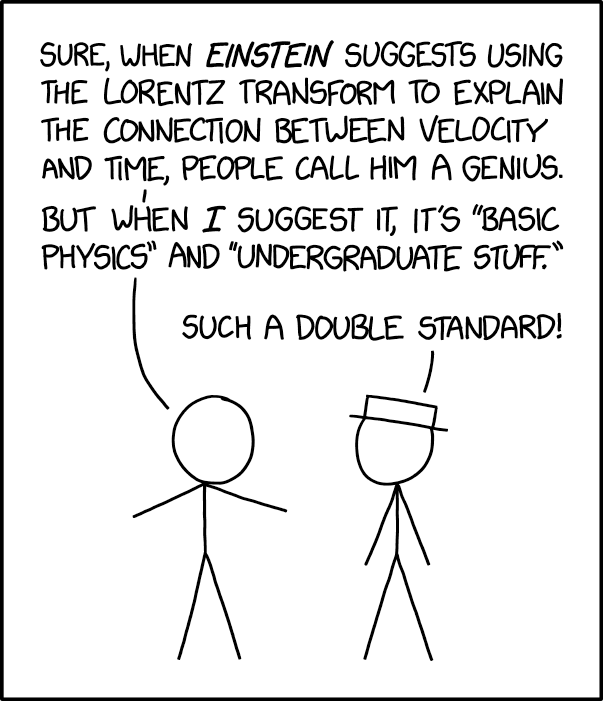
From xkcd comic.

Lorentz did publish a detailed paper on how transforms explain the connection between velocity and time, in 1895, ten years before Einstein. FitzGerald and Voigt even had some similar ideas before that. Lorentz got the Physics Nobel Prize in 1902. When Einstein published something similar in 1905, no one was too impressed. Idolizing Einstein came later.

Monday, October 13, 2025

Einstein may have Died of Syphilis

I have posted a lot about Albert Einstein, but not much about his personal life.

From a Wash. Post book review a few months ago:

Einstein’s own efforts at ascension were not entirely successful. When he tried to transform himself into a spiritual leader nearly two decades after he was celebrated for his scientific accomplishments, he founded a movement called Cosmic Religion that garnered few converts. The reaction from notable representatives of both science and faith was for the most part negative. One prominent Catholic monsignor said, “There is only one fault with [Einstein’s] cosmical religion: he put an extra letter in the word — the letter ‘s.’” Niels Bohr, upon hearing Einstein quip that “God does not play dice with the universe,” scolded him, telling him to please stop telling God what he could do.

Scholars who have studied his private life have noted that his ex-wife, Mileva Marić, who became pregnant before their marriage with a daughter who never met her father, was found lying unconscious on the road shortly before her death. She had been walking through icy streets trying to reach their younger son, whom she cared for after Einstein left the family to marry his cousin Elsa. And Elsa, in turn, eventually learned to live with infidelities so numerous that Einstein’s personal doctor claimed without evidence that the aortal aneurysm to which he succumbed was probably a result of syphilis. In light of the publication in 1993 of some of the most cruel and salacious aspects of his private life after years of litigation against the Einstein estate, his granddaughter Evelyn Einstein felt vindicated: “Nobody likes to see their sacred cow criticized, but it is about time the real story came out.”

It links to a 1994 book saying Einstein was a misogynist who abandoned and mistreated his children.

Einstein historian Galina Weinstein has her own criticism of the book reviewed above, and she just tweeted about it. While she vigorously defends him on many fronts, she does not seem to deny that he was a horrible person in his private life.

His political views were also abominable, as he belonged to several Communist front groups.

He was primarily known as a physicist, so maybe he should be judged solely on that. Okay, I could accept that, until I read Einstein scholars saying that we must accept his accounts of how he discovered relativity, and that we should not denigrate him in a way that evokes ugly Jewish stereotypes.

No, he lied about relativity all his life. I do not accept anything he said, unless it can be independently verified. I don't think it necessarily has anything to do with being Jewish. Most Jews are much more honorable than Einstein.

Friday, October 10, 2025

Weinstein Against Einstein Ad Hominems

I criticized Galina Weinstein, and commented on another rebuttal. Now she has posted a 19-page response:
This paper provides a systematic response to the criticisms raised by Jean-Marc Ginoux in response to my review of his book on the history of relativity. Whereas my review was written in a strictly academic manner, Ginoux's commentary intermingles mathematical objections with ad hominem insinuations about both Einstein and me.
She is the one with the ad hominems, as you shall see below. She avoids the biggest criticisms from Ginoux and myself.
Ginoux argues that Einstein’s retrospective statements—such as his 1955 letter to Carl Seelig, in which he wrote that he was unaware of Poincaré’s 1905 note [Bor] — should be dismissed because “Einstein, like many others, lied to his wife, his children, and also to his colleagues. So, why should we believe what he says about this article?” [Gin-2]. This reasoning collapses private life into a wholesale claim of intellectual dishonesty.

Methodologically, that is untenable; the personal failings of a scientist cannot be marshalled as evidence against their scholarly testimony. To reduce the question of influence in the genesis of special relativity to judgments about moral character is to leave the historical method for insinuation. As Einstein once remarked, “In the past, it never occurred to me that every casual remark of mine would be snatched up and recorded. Otherwise, I would have crept further into my shell” [DuHo].1

[footnote] ... There is also a well-documented polemical tradition casting Einstein as dishonest or derivative. ...

The substantive historical debate is, of course, legitimate: Did Einstein, before mid-1905, have direct knowledge of Poincaré’s work on Lorentz invariance? Were his results anticipated, and if so, in what sense? ...

What is not acceptable is to dismiss Einstein’s retrospective testimony by means of personal denigration or to frame the debate in terms that echo long-standing prejudicial tropes.

Einstein was not just dishonest in his personal life. He lied about the origins of relativity his entire life. It is not just that his 1905 relativity paper cited no references, but his followup papers, review papers, interviews, and everything else avoided Poincare. He just mentioned Poincare a couple of times in his whole life. As she says in the footnote, his dishonesty and plagiarism is well-documented.

She has a lot of discussion about the many striking similarities between Einstein and prior Poincare publications. In particular, using light signals to synchronize clocks, and postulating the relativity principle. Scholars disagree on how much was plagiarized. The most compelling point to me is that he never came clean, and tried to explain which Poincare works he used, or to credit Poincare's priority.

Einstein did eventually explain that his relied on Lorentz's 1895 relativity theory, constant speed of light, contraction, analysis of Michelson-Morley, and local time, and denied that he read Lorentz's 1904 paper. Maybe he was telling the truth, although Logunov presents evidence that Einstein read that 1904 paper. Einstein published 21 reviews in a journal that also reviewed Lorentz's paper, so it is hard to see how he could have missed it.

But there is no explanation like this for Poincare. Poincare was possibly the most widely read scientist in all of Europe, and Einstein read French. It is a certainty that Einstein read Poincare's relativity works. Even if Einstein's failure to cite Poincare in 1905 is somehow excusable, there can be no excuse for not crediting him in later papers.

She says that the debate is over whether Einstein knew about Poincare's works, and it is unacceptable to question his integrity. Yes, of course I am going to question his integrity, because that is the only way to answer the question. There is no historian who says Einstein did not know about Poincare's works, and no historian who has any excuse for Einstein not citing Poincare.

Her strangest comment is to say that Einstein's honesty must not be questioned, because it is unacceptable "to frame the debate in terms that echo long-standing prejudicial tropes." Apparently this is a veiled reference to a stereotype of Jews being dishonest plagiarists, and as being parasitic, unoriginal, morally corrupt, and eager to appropriate the achievements and culture of others. For more on this subject, see this essay on how the Nazis considered Jewish Physics inferior to Deutsche Physik.

She works for an Israeli university, and I guess it is her duty to defend the honor of a great Jewish intellectual.

Galison has offered a subtle explanation for Einstein’s style in the 1905 relativity paper. Einstein had been trained in the patent office, where clarity, compression, and originality were paramount. Patent applications never cite prior patents or scientific works, for the very logic of the system demands that the invention stand on its own, free of genealogical entanglements.
I am a patent agent myself, and this is false. Patent applications nearly always cite prior patents and scientific works. The whole point of the application is to show that the invention is different and better than the prior art. Even if an application did not include references, the patent examiner would add them. They are essential.
Ginoux’s argument hinges on Einstein’s use of the word überflüssig (“superfluous”) in his 1905 relativity paper, as if this meant that Einstein only sidestepped the ether rather than abolishing it [Gin-2]. This reading is misleading. In German scientific usage, überflüssig means not “almost unnecessary,” but “dispensable,” “without function,” “obsolete.” When Einstein writes that the introduction of a “light ether” will prove überflüssig, he is saying that the ether is not required to account for electrodynamic phenomena. That is abolition in the strictest physical sense.
That is still essentially the same as Lorentz's 1895 paper saying "It is not my intention ... to express assumptions about the nature of the aether." And Poincare saying in 1889, "Whether the ether exists or not matters little - let us leave that to the metaphysicians". (The word can be spelled aether or ether.)

I think that there is overwhelming evidence of plagiarism, but regardless, the fact remains that Einstein's 1905 paper added nothing to the relativity theory created by Lorentz and Poincare. They had the Lorentz group, 4-vectors, spacetime metric, covariant Maxwell equations, and gravity. Einstein had a lesser theory, similar to what Lorentz had in 1904.

So even if Einstein rediscovered some aspects of relativity independently, he was merely giving a version of a theory that had already been published.

She asks whether Einstein's 1905 results were anticipated? The answer is yes, that everything in that paper was done better in previous publications.

She ends by saying that Poincare did cite Einstein in his last 1912 lecture:

ELECTRON DYNAMICS

more precise, this principle will be verified with more precision." In 1901, H. A. Lorentz had modified his theory so as to account for all observations, including Michelson's. He already used the "Lorentz transformation." The confidence inspired by the equations of the electromagnetic field was so strong that no one thought of correcting them, but rather tackled kinematics and mechanics, imagining that they must be affected by absolute motion in order to compensate for the influence of this motion on the phenomena of electrodynamics. But it is in the 17th volume of the Annales of Physique 1905 that we find Einstein's work on the principle of relativity considered in a methodical manner.

I do not even get the point of most of her arguments. Yes, Poincare acknowledged that Einstein published a paper on relativity. So what?

She starts her paper saying:

the difference between formal structures — equations, group properties, calculational devices — that were indeed available to Lorentz and Poincaré by mid–1905 and the conceptual framework inaugurated by Einstein in June 1905, in which simultaneity is practically defined, the ether is rendered superfluous, and the Lorentz transformation is derived from two coequal postulates. My aim here is not to diminish Poincaré’s formidable contributions; it is to clarify what counts as founding a theory, and to separate reconstruction from documentation.

In what follows, I confine myself to dated publications, manuscripts, and verifiable correspondence. I avoid psychologizing — about Einstein, myself, or any other figure — and I do not treat private life or character judgments as evidence. Priority and influence should be argued from documents, not insinuations.

In his comment, Ginoux challenges my interpretation of Einstein’s independence in 1905 and, in doing so, introduces remarks that go beyond scholarly disagreement. While my review was written in a strictly academic manner, addressing only the content of his book, his reply includes ad hominem statements about both Einstein and me.

No, not really. Her aim is very much to diminish Poincare, and to slander anyone who criticizes Einstein.

If she confined herself to verified sources, then the inescapable conclusion is that Lorentz and Poincare had all of special relativity in 1905. That is what Whittaker concluded in his 1953 book. If she and the other Einstein scholars were to simply describe what Lorentz, Poincare, and Einstein published, then I would have no quarrel.

No, she argued that Poincare's understanding was deficient. That he failed to take the decisive step. In the above quote, she argues that Poincare having all the formal structures does not count as founding the theory. And she later insinuates that any disagreement is based on Nazi tropes.

She could have recited what Lorentz, Poincare, and Einstein said about the aether, but that would not convince anyone to credit Einstein. She could explain how simultaneity is practically defined, but that would be Poincare's papers of 1898, 1900, and 1904. Likewise, she could have explained how they each derived the Lorentz transformations, but it is not clear why one would be better. Relativity textbooks commonly give other derivations as well. She could explain Einstein's two postulates, but she would have to say that they were published by Lorentz and Poincare years earlier.

So that leaves crediting Einstein for re-deriving the Lorentz transformations "from two coequal postulates", neither of which was original to him. That's all. Poincare had the postulates, but I guess he did not say that they are "coequal", whatever that means.

By comparison, Poincare had the Lorentz group, 4-vectors, spacetime metric, covariant Maxwell equations, and gravity, all in 1905, and all years before Einstein even understood these concepts. The canonical special relativity theory of 1910 until today is the one we got from Lorentz, Poincare, and Minkowski, not Einstein.

She argues:

The real point of contention is not whether Poincaré made profound contributions — he did — but whether Einstein’s 1905 paper represents merely an echo of those contributions or a decisive reconceptualization. I maintain, in line with much of the existing scholarship ([Nor, Sta02] and others), that Einstein’s achievement lay in relocating the Lorentz transformations into an ether-free, principle-based kinematics.
I thought she was going to say that Einstein founded a new theory. No, he just had a reconceptualization of Poincare's theory. Poincare's theory was also aether-free, so the supposed achievement is the "principle-based kinematics". Poincare's theory was also principle-based. So the difference is that Poincare had a 4D spacetime theory with a Lorentz symmetry group, and Einstein had a kinematic reconceptualization, whatever that is. This is how she, and other Einstein scholars, desperately try to find something original that can be attributed to Einstein, even if it has little to do with special relativity theory.

Wednesday, October 8, 2025

No Nobel for Quantum Supremacy

Some were hoping that the Nobel Physics Prize would go to Google or IBM for proving quantum supremacy. Instead, the Swedes announced:
“This brings quantum physics from the subatomic world onto a chip”
One of the recipients led Google's quantum supremacy work, but that was conspicuously absent from the announcement.

The obvious conclusion is that the Swedes had a hot debate on awarding quantum computers, but decided against it.

Monday, October 6, 2025

Galina Weinstein tries to Retrofit Einstein Again

Israeli scholar Galina Weinstein describes herself:
Specialist in Einstein’s Writings & Theories. I specialize in Einstein studies and have published extensively on the topic.
She just posted yet another paper on why Einstein deserves all the credit for special relativity, while Lorentz and Poincare were too stupid to know what they were doing.
Lorentz, Poincaré, and Einstein: Rethinking Doppler, Aberration, and the Fresnel Drag

Galina Weinstein

This paper examines Lorentz's 1895 derivations of the classical Doppler formula and Fresnel drag, Einstein's 1905 derivation of the relativistic Doppler effect and aberration, and Einstein's 1907 kinematical route to the exact velocity composition law from which Fresnel drag is obtained as a low-velocity limit. Einstein acknowledged that he had read Lorentz's "Versuch" well before 1905. In 1907, Einstein identified Lorentz's "Versuch" as a crucial precursor to relativity. In that work, Lorentz had already invoked local time to derive Fresnel's drag coefficient from Maxwell's equations. There is a genuine "family resemblance" between Lorentz's and Einstein's treatments in that both preserve the phase of a plane wave under transformation. Yet I demonstrate that this resemblance is only formal. I also discuss the absence of the relativistic Doppler and aberration laws in Poincaré's Dynamics of the Electron.

So Einstein admitted in 1907 that his famous 1905 relativity paper was based on Lorentz's 1895 Versuch paper. Einstein's 1905 paper closely resembles Lorentz's 1895 paper, as she says, but Einstein did not cite it. In other words, this was flagrant plagiarism.

Nevertheless she finds wacky reasons to ignore the plagiarism and credit Einstein. She cannot deny that Lorentz and Poincare had the whole theory before Einstein, so she has to claim that they somehow did not understand what they were doing.

I have criticized her in the past, most recently here, here, and here, and found her papers riddled with errors, smokescreens, and misrepresentations. She has not responded to these criticisms. She often criticizes other scholars, in Einstein's defense.

She keeps claiming that Einstein took the "decisive step", but she can never put her finger on what that step is.

First, that step is not "that no preferred ether frame exists." Special relativity does not depend on the aether, or lack of aether, or nonexistence of a preferred frame. These things have no bearing on the predictions of relativity. Einstein's 1905 paper did not say whether the aether exists, or whether a preferred frame exists. These are all modern misunderstandings of relativity.

Lorentz's 1895 and Einstein's 1905 papers say the same thing about the aether -- that it is not needed for the theory. Both papers choose reference frames that are "at rest" or "stationary", but emphasize that they are equivalent to other frames, in the sense that a change of variables makes Maxwell's equations look the same.

Poincare went a step further in 1905 and showed that the Lorentz transformations make a symmetry group relating the frames, and inducing relationships in the electromagnetic variables. For years, he argued that belief in the aether was a mathematical convenience.

This point is at the core of her misunderstandings.

In the above paper, she goes into detail to credit Einstein with ideas that Lorentz or Poincare published years earlier. One of her main examples is that Einstein published the velocity addition law in 1907. Poincare had already discovered it in a May 1905 letter to Lorentz, as she acknowledged in a 2012 paper. Einstein relied on the relativity principle in 1905, but that was copied from what Poincare wrote years earlier. As she explains:

Poincaré went further than Lorentz by recognizing the group properties of the transformations and emphasizing the principle of relativity. Yet he too remained within the conceptual confines of the ether, with all the limitations this entailed. ... The deeper reason is ontological. Like Lorentz, Poincaré retained the ether — conceived as a real, if undetectable, medium — as the ultimate backdrop of electrodynamics. This commitment barred him from taking the decisive step that Einstein did in 1905.
After the first sentence, this is gibberish. Poincare had a group symmetry identifying any inertial frame with any other. An undetectable aether could not possibly limit his theory. Einstein himself denied that he abolished the aether.

I am baffled as to how she can say anything this stupid. She either misunderstands relativity, or does not know what a symmetry group is, or she is bluffing with buzz words to puff up Einstein's reputation.

She has lengthy discussions of some side issues, like stellar aberration. Apparently there is some literature on whether Einstein misunderstood aberration. I have no opinion on this. Einstein's treatment was more or less the same as Lorentz's ten years earlier, and does not have much to with priority for relativity.

In the paper, she writes some formulas and then imagines that Einstein could have written them but not Poincare.

Now, that is retro-fitting Einstein’s conceptual step into Poincaré’s framework. It is not something Poincaré himself could have justified in 1905. Here, we declare the phase to be invariant under Lorentz transformations (66). In modern language, this means the phase is a relativistic scalar. This is not just a calculation move. Making the phase invariant was a conceptual step, not a purely technical one. That is a very Einsteinian step because it assumes that all inertial frames are equivalent and that no preferred ether frame exists.
What she is saying here is that Einstein would have understood the concept of a relativistic scalar, but Poincare would not have. She literally says that considering a Lorentz invariant is an "Einsteinian step".

Again, I am baffled at how she can say something so ignorant. Einstein does not have the concept in 1905, and appeared to not understand it until many years later. But Poincare has relativistic scalars in his long 1905 paper.

A relativistic scalar is a function that is invariant under Lorentz transformation. More generally, a relativistic vector or tensor obeys geometric formulas for Lorentz transformations. Sometimes these are called covariant (or contravariant) and 4-vectors or 4d tensors.

Poincare's long 1905 paper devotes several pages to finding relativistic scalars. He finds the Minkowski metric, E*B, and E²-B², where E and B are the electric and magnetic fields. The latter is particularly interesting because it forms the Lagrangian density for Maxwell's equations, with no charges. When there are charges or currents, there is an extra term.

This is all explained in detail in Henri Poincare and Relativity Theory by the Russian, A. A. Logunov, 2004.

Lorentz group invariance goes to the heart of what special relativity was all about. The chief accomplishment was to express Maxwell's equations in a way that behaves properly under Lorentz transformations, thereby realizing the Maxwell theory as a relativistic theory.

This idea is what sold everyone on the theory. The Maxwell theory had decades of experimental verification, but it left puzzles such as the inability to detect the Earth's motion through the aether. Suddenly it all made sense, with relativity.

Poincare proved this in two ways -- by providing a Lorentz invariant Lagrangian, and by using a 4-vector electromagnetic potential. Minkowski added a third, showing a covariant field tensor.

Einstein understood none of this. According to Logunov, he was still confused about it in 1933. I think he probably figured it out around 1913.

What Einstein did do in 1905 was to re-derive Lorentz's 1895 Vorsuch theorem of the corresponding states. This meant that there were ways to change variables so they satisfy a version of Maxwell's equations in a moving frame. Einstein's theory was equivalent to Lorentz's,

The preferred view today, pioneered by Poincare and Minkowski, is that relativity is a spacetime theory. The Lorentz transformations form a symmetry group of spacetime. Relativistic scalars, vectors, and tensors obey those symmetries. The laws of physics are formulated in terms of those tensors, and the switch to a moving frame is an automatic consequence of the geometry. The transformation of Maxwell's equations is induced by the transformation of spacetime.

By doing it this way, Poincare established relativity as a theory applying to all the laws of physics. He even applied it to gravity in 1905. The Lorentz-Einstein version was a way to understand the relativity of electromagnetism, but it was unclear whether and how it would apply to something else, like gravity.

I spell this out because Weinstein's arguments for crediting relativity require ignoring the heart of the theory. She says Lorentz and Poincare did not take the decisive step, but Einstein was the one not taking that step. The essence of relativity is the non-euclidean geometry on spacetime, and laws of physics respecting that geometry. Poincare and Minkowski had it, and Einstein did not.

Thursday, October 2, 2025

Quantum Computer Pessimism

Quantum computer researchers report progress all the time, but Craig Gidney reports:
In 2001, quantum computers factored the number 15. It’s now 2025, and quantum computers haven’t yet factored the number 21.
And Sabine Hossenfelder has gone negative on there ever being any applications.

Scott Aaronson attacks an HBSB-IBM announcement of quantum advantage.

Wednesday, October 1, 2025

Biggest Concepts in Mathematics

What are the most important concepts in Mathematics? Here is my list.
  1. Proof. Also logic, axiom, finitary proof.
  2. Infinity. Also limit, continuity, calculus, analysis.
  3. Set. Also number, function, more abstract objects.
  4. Symmetry. Also group, geometry, isomorphism.
  5. Probability. Also statistics, sampling, conditionals.
  6. Convexity. Also linearization, optimization.
No surprises here, except for that last one. I expect most readers to say convexity is just a trivial property of some sets and functions, and not really of fundamental importance.

That is what I used to think, but now I have concluded that convexity is at the core of most real-world applications of math.

In particular, convexity is crucial to the math of artifical intelligence AI.

Another crucial math idea in AI is:

The manifold hypothesis posits that many high-dimensional data sets that occur in the real world actually lie along low-dimensional latent manifolds inside that high-dimensional space.[1][2][3][4] As a consequence of the manifold hypothesis, many data sets that appear to initially require many variables to describe, can actually be described by a comparatively small number of variables, linked to the local coordinate system of the underlying manifold. It is suggested that this principle underpins the effectiveness of machine learning algorithms in describing high-dimensional data sets by considering a few common features.
Another is the various scaling and power laws:

In statistics, a power law is a functional relationship between two quantities, where a relative change in one quantity results in a relative change in the other quantity proportional to the change raised to a constant exponent: one quantity varies as a power of another. The change is independent of the initial size of those quantities.
With AI becoming more important, I expect the math of AI to also become more important.

Monday, September 29, 2025

Latest Silly Paper on Superdeterminism

Someone on Aaronson's blog attacked me for not wanting to read papers on superdeterminism. Here is the latest such paper, by Waegell, Mordecai and McQueen, Kelvin J., so you can see for yourself what garbage it is.
Bell’s theorem demonstrates that any physical theory that is consistent with the predictions of quantum mechanics, and which satisfies some apparently innocuous assumptions, must violate the principle of local causality.
Those innocuous assumptions include being a classical theory, so quantum mechanics can still satisfy local causality and the Bell test experiments. The whole subject is only interesting to those who want to deny QM.
What then are we to make of the scientific status of superdeterminism? Should we deem it unscientific or pseudo-scientific? ...

Superdeterminism, presently, is therefore neither scientific nor unscientific, it is better thought of as being in a pre-scientific stage, where we are still coming to grips with what such mod- els require, and we are only just beginning to propose simple toy models

This is like what Peter Woit calls Not even wrong. Not only is there no way to test it, there is no way to even say whether the theory can be made scientific or not.

The Flat Earth people say that a round Earth violates their intuitions, so they look for evidence for a Flat Earth. The superdeterminism folks are much worse. They say that QM violates their intuitions, but make no attempt to find evidence against QM. Instead they theorize that a primordial conspiracy is tricking us into thinking the evidence favors QM.

No, the superdeterminism papers are not worth reading.

Wednesday, September 24, 2025

Another Galina Weinstein Rebuttal

Einstein scholars have been giving bogus arguments for decades to prop up his reputation for relativity. One of the worst offenders is Galina Weinstein. I have criticized her many times, most recently here.

Now Jean-Marc Ginoux has written a rebuttal to her criticism of his Poincare book.

Unfortunately, Weinstein’s review of my book contains a number of mistakes, falsehoods and misleading criticisms that I would like to point out here. To this aim, I will follow the structure of Weinstein’s paper and show section by section all the erroneous historical facts she has reported.
Weinstein accepts Einstein's lies:
Here, the conflict of interest is obvious since the only witness on which these claims are based is Einstein himself. So, we must believe him according to Galina Weinstein because Einstein necessarily always tells the truth. This is unfortunately not the case and the biographies (see Albert Einstein Demystified, Ginoux [10]) I wrote on Einstein demonstrate this. Indeed, Einstein, like many others, lied to his wife, his children and also to his colleagues. So, why should we believe what he says about this article? Sorry but this is clearly not enough.
The takedown is brutal. I mainly argued that Weinstein's biggest arguments were demonstrably false. Ginoux details her minor claims, and finds most of them to be false also.

Most historians do credit Einstein for special relativity, and I wonder how they get away with it. Their arguments are fallacious and they ignore the hard evidence. Most of what they say is just nonsense. She is a professor at an Israel university, so maybe she never hears any Einstein criticism. She relies on Einstein historian John Stachel, who was well-trained in Communist doubletalk.

It is very surprising to observe for decades how some historians of science are able not to reconstruct but really to rewrite the development of the theory of special relativity by inventing imaginary facts or by interpreting real facts in a incredible manner. I think that the paper of Galina Weinstein is one of the best examples of what can be done in this case and it should be used to learn how to recognize fake news. ...

The third type of argument is more dangerous but very classical: "the falsehoods". As an example, she explains that in his contribution entitled "La mesure du temps" Poincaré [22] already used the concept of luminiferous ether although even the expression does not appear in this paper as it is easy to verify. ...

Here appears a new kind of argument: "same but different". Poincaré and Einstein’s results seem to be the same but they are different. Why? This is not crystal clear.

The same-but-different argument is a real head-scratcher. At best it would only show that Einstein had an improved interpretation of the previously published Lorentz-Poincare theory. But the Einstein fans would never be happy only crediting him for that.

As an example, she quotes Stachel about Einstein:

the ether he reintroduced differed fundamentally from the ether he had banished [Sta-01].
If that is their story, they should stop saying Einstein abolished the aether, and instead say he had some different subtle philosophical interpretation of it.
It is very regrettable that some historians of science are capable of using such methods to defend an indefensible point of view which does not stand up to analysis of the facts. Let us recall to them Poincaré’s words:
Thinking must never submit itself, neither to a dogma, nor to a party, nor to a passion, nor to an interest, nor to a preconceived idea, nor to whatever it may be, if not to facts themselves, because, for it, to submit would be to cease to be [27].
I wonder if Weinstein will respond to these criticisms. She has aggressively attacked other scholars who did not adequately credit Einstein. Here she stands accused of "a complete misunderstanding of the theory of special relativity". as well as misrepresenting the original sources.

In my view, the different presentations of special relativity are not all the same. Einstein's is more or less the same as Lorentz's, and Minkowski's is essentially the same as Poincare's. The Poincare-Minkowski version became the canonical one, after about 1910.

Update: The Ginoux rebuttal is also posted here.

Monday, September 22, 2025

Quantum Theory was not a Paradigm Shift

A philosopher of science says:
I mean in Kuhn's terms of course quantum 48:20 theory is a paradigm shift. i mean no one would dispute that but A paradigm shift 48:25 from what? ...

quantum mechanics is certainly a paradigm shift from Newton from 49:17 classical mechanics and and from classical electromagnetic theory, Maxwell 49:22 for sure, nobody's going to dispute that.

Yes, I dispute that. Prof. Paradigm Shift himself wrote a book on the history of quantum mechanics, and the book did not call it a paradigm shift.
In the 1960s Kuhn’s historical work turned toward the early history of quantum theory, culminating in his book Black-Body Theory and the Quantum Discontinuity. ... Many readers were surprised not to find mention of paradigms or incommensurability.
A paradigm shift is when an old theory turns into a new theory with a new point of view, even though the new theory is not better in any measurable way. This notion of incommensurability is central to Kuhn's whole philosophy. His main example was the 1543 Copernicus book about the revolution of the Earth around the Sun. The ideas eventually became accepted, in spite of the lack of measurable advantages.

Scientists like brag about a paradigm shift when they have no measurable results to brag about.

If this sounds kooky, it is, but it is the most widely praised philosophy of science in the last century.

So I try to use the term accurately. A paradigm shift is not a scientific advance. Kuhn called that normal science. A paradigm shift has no measurable or objective advantages.

That is why the philosophy became popular. Some people, such as leftist soft scientists, like to deny objective knowledge, so they loved Kuhn's philosophy.

One could say that special relativity was a paradigm shift from Maxwell electrodynamics. Relativity was a reinterpretation of Maxwell as a relativistic theory, making all the same predictions for electromagnetic phenomena. There are Tests of special relativity, but they all require some interpretation, just like tests of the Earth's motion. The Michelson-Morley experiment tested both the Earth's motion and special relativity, but nothing happened, so it took a lot of interpretation to see what theories it supported.

This raises a paradox that I have not seen addressed. Maxwell's equations are covariant under Lorentz transformations, so the theory is fully relativistic. There are only four fundamental forces, and most ordinary phenomena are purely electromagnetic. That means that they are explainable with the Maxwell theory without relativity. So how would any experiment test and confirm special relativity?

Special relativity is considered to be experimentally confirmed, so this is a paradox.

Michelson-Morley can be explained with just the Maxwell theory. Other experiments involving time and mass are trickier. Relativity redefines how clocks are synchronized, so time is measured differently under relativity. Experiments with timings require relativity to get the times right.

There must be physics literature detailing this issue, but I do not know it.

Wednesday, September 17, 2025

New Ginoux Book credits Poincare for Relativity

The Einstein scholars cannot tolerate anyone but Einstein getting credit for relativity, and now Galina Weinstein has just posted:
Jean-Marc Ginoux's recent book, "Poincaré, Einstein and the Discovery of Special Relativity: An End to the Controversy" (2024), seeks to close the debate over the respective roles of Poincaré and Einstein. Yet what is presented as an "end" may instead invite a more careful analysis of how similar equations can conceal divergent conceptions. The aim here is not to rehearse priority disputes but to show how Einstein's ether-free, principle-based kinematics marked out a path that, unlike its contemporaries, became the canonical form of special relativity.
The book abstract:
1905 is probably the best-known year in physics, since it was the year of the discovery of the special theory of relativity. For decades, historiography has told us that Albert Einstein, then a patent examiner in Bern, succeeded in developing this theory on his own, overcoming all the difficulties that the greatest scientists of his time had not been able to solve. However, some have pointed out that, before Einstein’s first publication in this field, the French mathematician and physicist Henri Poincaré had obtained the same results, which he had published several months before Einstein. Yet today, this theory is known as Einstein’s special theory of relativity. Thus, considering the indisputable anteriority of Poincaré’s contributions, there is only one real question that needs to be answered: Why didn’t Poincaré claim the authorship of special theory of relativity? After recapping on the ideas and concepts of the special theory of relativity in a manner accessibleto non-specialists and recalling the historical context of the discovery of this theory, we will answer this question and thus put finally an end to this long-running controversy.
He wrote this rebuttal, also here, to a negative review.

The book points out that Poincare had the entire theory of special relativity, with all the equations and physical consequences, in 1905, with a short summary, a long paper, and private letters to Lorentz. These were finished and submitted long before Einstein submitted his famous 1905 paper. The summary was even published and in a university library available to Einstein, while he was writing that famous paper.

Most of this is well-known, as Whittaker's 1951 book said that Lorentz and Poincare had the whole theory before Einstein. Einstein was shown the book while he was still alive, and he had no rebuttal. His friend Max Born tried for three years to persuade Whittaker of Einstein's originality, but ultimately decided that Whittaker was right. Wikipedia says the book was well-received, but no one wanted to cite it out of fear of the Einstein controversy.

Weinstein cannot deny any of these facts, but she concocts goofy arguments on why Einstein should be credited anyway. She cites his 1955 denials that he knew about important works by Lorentz and Poincare, but admits that there is strong evidence that he relied on some of them.

She attacks Poincare:

And yet, a few years later, in his 1912 London lecture, he was speaking the idiom of Minkowski space and edging toward Einstein’s own perspective.

In his London lecture of May 1912, Poincaré spoke of a “révolution en physique.” No ether was invoked. Instead, he described how a sphere for one observer becomes an ellipsoid for another, how simultaneity dissolves once observers move with respect to each other, and how time itself interlaces with space as a fourth dimension — mathematically rotated by Lorentz transformations. One even hears the unmistakable echo of Minkowski in his remark that the fourth coordinate is best taken as t√−1. Finally, he underlined that in this nouvelle mécanique, causal influence can propagate no faster than light, so that certain pairs of events can stand in no relation of cause and effect at all [Poi12].

Read in isolation, the passage might almost pass for a lecture by Einstein himself — save for the French accent and the courtesy of quotation marks. By then, however, Einstein had already made simultaneity operational, abandoned the ether, and embraced Minkowski’s geometry. The irony is hard to miss: Ginoux asks why Poincaré never claimed authorship of relativity [Gin], yet Poincaré’s own words, in the last public address of his life, sound less like a claimant and more like a convert. The revolution, it seems, was already underway — only the naming rights remained unspoken.

No, using t√-1 as the fourth coordinate was invented by Poincare and described explicitly on p.168 of his long 1905 paper. Minkowski first used it in his 1907 paper, and he cites Poincare. Poincare was giving his own 1905 perspective, and not edging towards Einstein's perspective.

It is baffling how Weinstein could make a mistake like this. She has spent most of her career writing about 20 papers and 3 books crediting Einstein over Lorentz and Poincare for relativity, and she attacks Poincare for copying Minkowski for an idea that was plainly original to Poincare and copied by Minkowski. Einstein resisted Minkowski's approach for years and never credited Poincare.

Her papers mostly consist of burying the reader with technical details from original documents, so he will accept her pro-Einstein opinions as authoritative.

As you can see here, the idea of using imaginary time as the fourth spacetime coordinate was invented by Poincare, copied by Minkowski two years later, and reluctantly accepted by Einstein years after that, and she thinks that Poincare was just trying to sound like Einstein!

The book addresses the question of why there was not more of a public priority dispute between Lorentz, Poincare, and Einstein. Poincare generously credited Lorentz, and explained how their theories differed. Lorentz credited Einstein for some insights, but argued that Einstein mainly just postulated what Lorentz and Poincare proved. Einstein almost never credited anyone for anything, and could never explain how his theory was any different or better than those of Lorentz and Poincare.

Poincare did recommend Lorentz for a Nobel Prize for his 1895 invention of relativistic time. Lorentz did get the prize in 1902, but the citation only mentioned electrodynamics and not his use of time specifically. According to the book, and Weinstein, Poincare did write, in support of himself being nominated for a Nobel Prize:

I have published an article in Rendiconti in which I explain the theory of Lorentz on the Dynamics of the Electron and in which I believe I have succeeded in removing the last difficulties and giving it perfect coherence.
This was the 9th of 13 scientific accomplishments, being considered for the prize. So he did claim credit for perfecting special relativity, if a Nobel Prize were given for it. If he perfected it before Einstein and Minkowski wrote anything on the subject, then I take this as a clear priority claim.

Ginoux and Weinstein are puzzled by these two questions: (1) Why didn't Poincare publicly claim credit for relativity; and (2) Why is it that, when Poincare gave a dozen or so public lectures about relativity, he generously credited Lorentz and those coming before him, but never mentioned Einstein, Minkowski, and those who came after? And why did he teach his own version of relativity, rather than that of Einstein or Minkowski?

These questions answer themselves. Poincare publicly lectured on relativity as his theory, derived from Lorentz, and he got no part of his theory from Einstein and Minkowski. Not mentioning the plagiarists was the gentleman-scholar thing to do. There was no need to get into any arguments, as Poincare published it all in widely read journals and books. The proof was there for anyone who bothers to look.

She and the above reviewer argue that Poincare should not be credited with a new theory because he only claimed to be perfecting Lorentz's theory, while Einstein was boldly not crediting Lorentz or Poincare. This is exactly backwards. Poincare credits Lorentz and then boldly claims a new theory which is different in the way that Copernicus was different from Ptolemy. See this page of his 1905 long paper. By contrast, Einstein does not explain how his theory is any different from Lorentz's 1895 theory, as improved in 1904. Einstein derives it from postulates instead of experiments, but the resulting theory is the same, and others called it Lorentz-Einstein theory.  So it was Poincare who boldly claimed a new theory, not Einstein.

Her most outrageous claim is:

Einstein’s ether-free, principle-based kinematics marked out a path that, unlike its contemporaries, became the canonical form of special relativity.
This is completely false. The canonical form of special relativity is the one with the Lorentz group, Minkowski spacetime, 4-vectors, non-euclidean metric, covariant equations, and Michelson-Morley experiment. All of these are absent from Einstein's 1905 paper. We get them from Poincare's 1905 papers.

She argues:

Yet the resemblance of formulas should not obscure the difference of foundations. The decisive difference lies not in whether both men spoke of rods, clocks, or signals, but in what they did with them. Poincaré preserved the ether, corrected Lorentz’s electron theory within electrodynamics, and treated local time as a useful fiction; Einstein discarded the ether, made simultaneity operational, and showed that the space and time transformations express a new conception of space and time.
All of that is false. It was Poincare, not Einstein, who said the aether was a convenient and unnecessary hypothesis. Lorentz and Einstein said the same thing about the aether. It was Poincare, not Einstein, who combined space and time into 4D spacetime. It was Poincare who published operational simutaneity in 1898, and she admits Einstein copied that. It was Poincare, not Einstein, who argued in 1905 that relativity applied beyond electrodynamics and into gravity.

She ends with this crazy analogy for crediting Einstein:

One suspects that, had he been listening, Einstein would have let the discussion run its course before offering only a shrug and the reminder that equations, like jokes, are all in the telling.
So Einstein plagiarized the whole special relativity theory, but somehow told the story better? Not even that is true, as everyone in 1910 preferred Minkowski's account, not Einstein's.

Ginoux wrote a sharp rebuttal to an earlier bad review, so I wonder if he will write another. Weinstein deserves someone criticizing her, besides me. I have posted many criticisms of her, most recently here.

Explanation of Newtonian Time

Matt Farr posted a new paper on Time in Classical Physics : Wigner (1995, 334) describes how Newton’s “most important” achievement was the ...