Stephen Hawking gave this lecture:
Many scientists are like Einstein, in that they have a deep emotional attachment to determinism. Unlike Einstein, they have accepted the reduction in our ability to predict, that quantum theory brought about. But that was far enough. They didn't like the further reduction, which black holes seemed to imply. They have therefore claimed that information is not really lost down black holes. ...Pierre-Simon Laplace lived around 1800 and not only proposed scientific determinism, he also predicted black holes and Bayesian probability. He said: "...[It] is therefore possible that the largest luminous bodies in the universe may, through this cause, be invisible." This idea was so far-fetched that it was removed from later editions of the book.
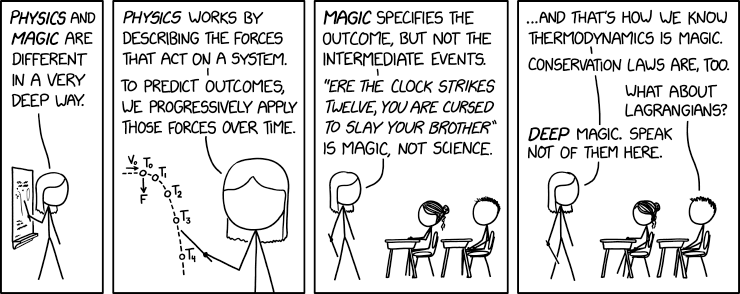
To sum up, what I have been talking about, is whether the universe evolves in an arbitrary way, or whether it is deterministic. The classical view, put forward by Laplace, was that the future motion of particles was completely determined, if one knew their positions and speeds at one time. This view had to be modified, when Heisenberg put forward his Uncertainty Principle, which said that one could not know both the position, and the speed, accurately. However, it was still possible to predict one combination of position and speed. But even this limited predictability disappeared, when the effects of black holes were taken into account. The loss of particles and information down black holes meant that the particles that came out were random. One could calculate probabilities, but one could not make any definite predictions. Thus, the future of the universe is not completely determined by the laws of science, and its present state, as Laplace thought.
Laplace was not so silly as to think that black holes have something to do with determinism. That takes a modern physicist with a big reputation and wacky ideas like Hawking. Laplace had a much better understanding of what science was all about.
The equations of quantum mechanics are not any more or less deterministic than the equations of classical mechanics. They both formally predict the future, but cannot be completely deterministic because the inputs cannot be completely known.
Einstein's view was what would now be called, a hidden variable theory. Hidden variable theories might seem to be the most obvious way to incorporate the Uncertainty Principle into physics. They form the basis of the mental picture of the universe, held by many scientists, and almost all philosophers of science. But these hidden variable theories are wrong. The British physicist, John Bell, who died recently, devised an experimental test that would distinguish hidden variable theories. When the experiment was carried out carefully, the results were inconsistent with hidden variables. Thus it seems that even God is bound by the Uncertainty Principle, and can not know both the position, and the speed, of a particle. So God does play dice with the universe. All the evidence points to him being an inveterate gambler, who throws the dice on every possible occasion.This argument for God playing dice is based on a mismatch between the mythical hidden variables and the observable variables. But if you accept those Bell test experiments, then the hidden variable do not exist, and the argument is fallacious. It tells us nothing about whether God plays dice or not.